
From ad-hoc to optimized: Why you need a content maturity model
The first time I came across a content maturity model, it was a lightbulb moment. A simple and elegant framework that captures the feeling of chaos and helps to translate it into an actionable strategy. I printed 2 copies – one for my wall and one to take with me from meeting to meeting. That was 10 years ago.
To this day, a content maturity model still helps me to prioritise efforts, communicate with stakeholders and not lose sight of the bigger picture.
What is a content maturity model?
A maturity model is a conceptual framework used to assess, measure and improve an organization's capabilities in a specific discipline.
Think of it like a map for your content operations. It helps to:
- figure out where you are (benchmark your content operations against industry standards)
- discover where you want to go (what your content operations could look like)
- set off in the right direction (implement standards and systems to improve your content practices).
There are 5 stages:
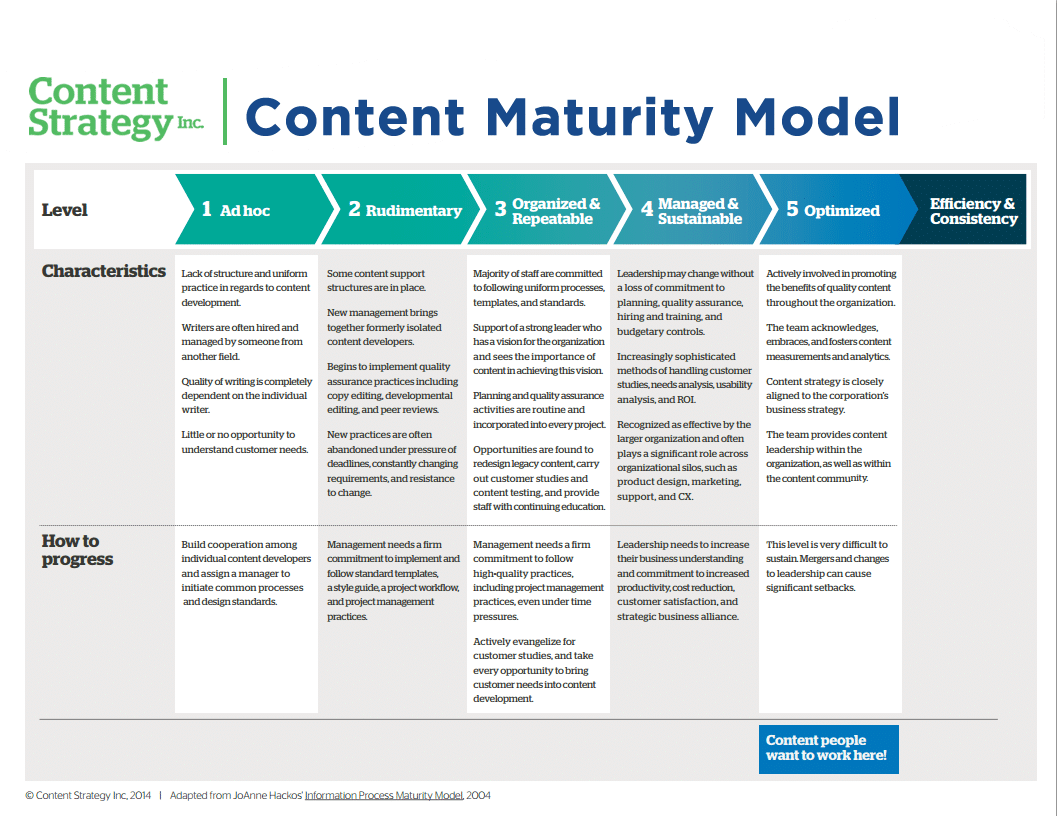
1. Initial – everyday is chaotic and quality depends on the individual writer.
2. Repeatable – basic processes exist but are siloed with inconsistent results.
3. Defined – standardized workflows, documented practices, and a shared language.
4. Managed – data-informed, strategic alignment, measurable impact.
5. Optimized – automation, continuous improvement, adaptive to change.
A quick search will return different versions. The one I printed out all those years ago is the content maturity model adopted by Content Strategy Inc. It highlights key characteristics for each stage, as well as a brief checklist to help you progress. It’s not just about identifying where you are, but how you get to where you want to be.
Understanding its origins
Back in the 1980s, the US government needed a way to objectively evaluate the ability of government contractors to deliver a software project. Computers had become more widespread and accessible, but the field of software development was still in its infancy. Carnegie Mellon University developed the Capability Maturity Model as a means to benchmark organizational processes.
Since then, similar 5-step frameworks have been repurposed for many business areas, including project management, IT and HR. While we’ve moved away from the strict, certification requirements of the original model, the core philosophy remains. Given the many parallels between content and code, it makes sense to borrow this tried-and-tested framework from our developer friends.
Make it yours
It goes without saying that a maturity model downloaded off the internet may not be quite right for your organisation. And it definitely won’t have all the information you need to overhaul your content operations.
As far as the map analogy goes, a maturity model is more like a treasure map than a modern GPS. It won’t give you an estimated time of arrival or tell you when to turn left. Like anything content-related, a lot of hard work will need to happen behind the scenes to make your journey a success. You’ll need to pack and prepare before you set off, and interpret your map within the context of your surroundings.
Show stakeholders the way
One of the hardest parts of being a content leader is explaining why we need to invest time in style guides, content audits and workflows.
Just like a map, a content maturity model is a powerful communication tool. Whether you’re trying to motivate a team or align with stakeholders, it provides a shared understanding of where you are and where you want to go.
When you can point to a model and show why a specific investment in processes or practices is the logical next step, you stop being 'just the content' and start being a strategic partner.
Focus on strategy
A content maturity model forces a paradigm shift. It moves the conversation away from the endless cycle of content creation and toward the scalable framework of content operations.
When you focus only on creation, you are fighting symptoms. When you focus on operations, you are building a system that allows your team and your content to work sustainably and strategically. A maturity model gives you the vocabulary to explain this shift to stakeholders who might be more accustomed to measuring success by the volume of content rather than its purpose.
Aim for progress, not perfection
It’s more helpful to think of content maturity as a gradual process, rather than a big-bang, multi-year transformation project. The model' linear nature helps to remove the paralysis of choice and stops you from getting ahead of yourself. You don’t have to solve every content problem at once.
By breaking down the path to maturity into manageable steps, a content maturity model prioritizes what needs to be done based on where you are. You just have to identify the actions that move your team from one stage of maturity to the next.
Checking in on your progress helps to keep you on the right track and allows you to celebrate wins along the way.
Revisit the map
A content maturity model is a framework for continuous improvement. The goal isn't to reach the final stage and then retire. The goal is to build a foundation that is resilient enough to handle whatever the next decade throws at your content.
People come and go, processes change and new technologies are adopted. As a result, content operations need to be reviewed and updated. A content maturity model can change with your organisation. It’s a tool you can come back to again and again.
In reality, 'Optimized' is very difficult for an organisation to reach, let alone maintain. But by providing a common language, the model helps your team to stay aligned, strategic and ready for whatever comes next.
References
Content Strategy Inc. (2014). The Content Maturity Model. Adapted from JoAnne Hackos’ Information Process Maturity Model (2004). Available at contentstrategyinc.com
Humphrey, W. S. (1989). Managing the Software Process. Addison-Wesley.