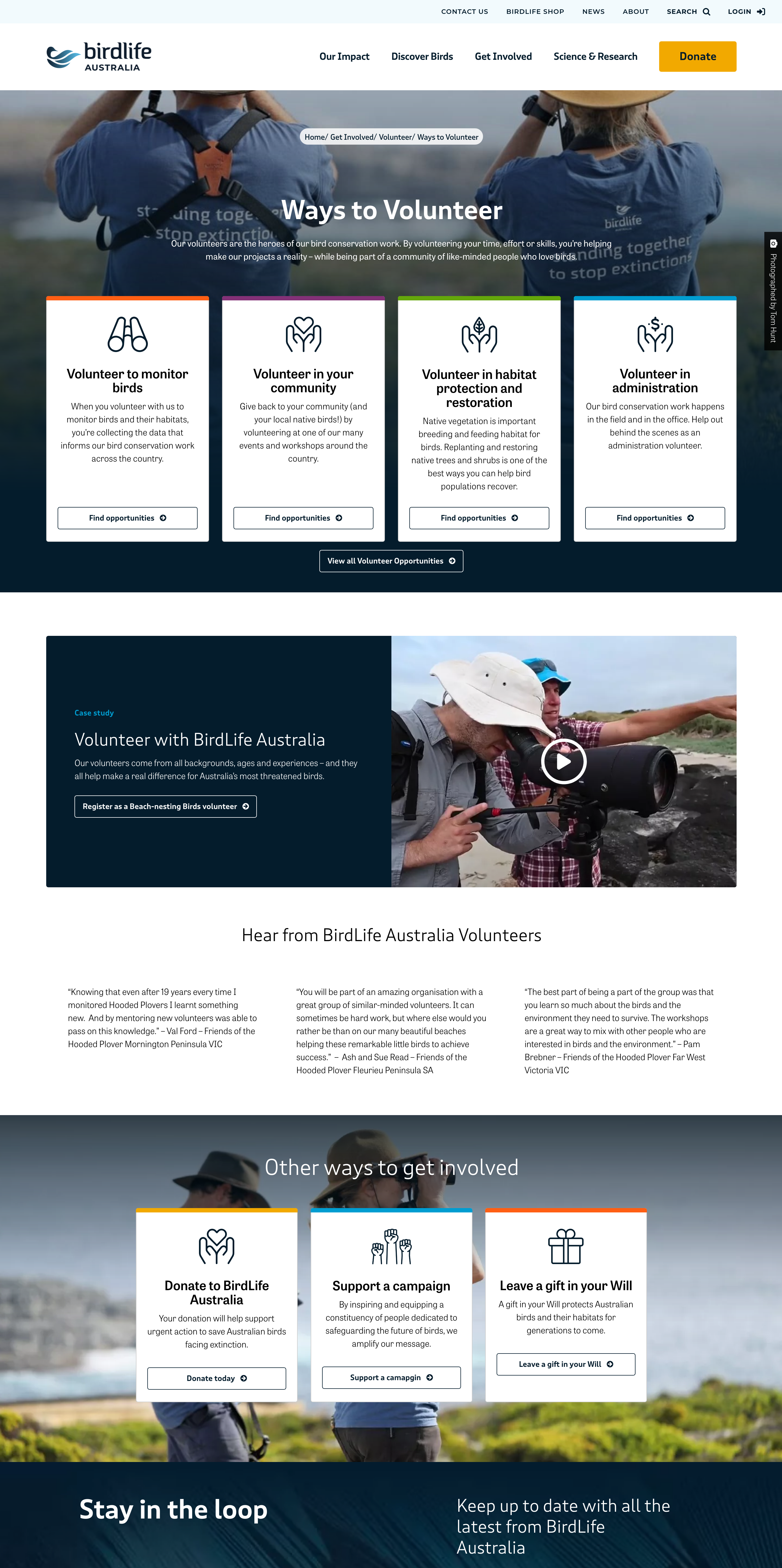
Case study: Creating a content strategy for a 37-website ecosystem
Client: BirdLife Australia
Role: Content Designer and Strategist
Overview
For 125 years, BirdLife Australia has championed conservation through science and community action.
However, a fragmented digital ecosystem made it difficult for users to donate and volunteer. Ad-hoc practices had led to outdated, duplicated and inconsistent content, which damaged user experience and brand identity.
I led the audit of 10,000+ web pages and developed a content strategy and design system to help BirdLife Australia create consistent, findable content across all 37 sites.
Challenge
The scale of the problem was the first major challenge. We needed a scalable approach to review content across the 37-site ecosystem.
Aligning this work also required bringing together a distributed network of stakeholders – including staff and volunteers. Volunteers authored much of the content, so the design system had to be robust yet simple enough for teams with varying skill levels to manage content.
Shifting from an organization to user-centered mindset was a prerequisite for the project's success. This required creating a unified presence with connected user journeys to support findability and engagement.
I found the initial navigating confusing. Mainly the connection between different areas within the whole system … It would be good if there was just one umbrella portal for all the BirdLife sites.
Approach
I analyzed existing user research to identify the 'top tasks' for each persona. I used this as a foundation for our content strategy, and identified how we could use content to tie what users wanted to do (for example, find volunteering opportunities) with BirdLife's strategic objectives.
To conduct quantitative website audits, I used Content Kit, a tool I had co-developed in 2021. This replaced weeks of manual work with clear, actionable data, which also served as a basis for our qualitative review. With an understanding of each site's purpose, audience and business needs. I developed a future-state content ecosystem and documented current-state content problems.
I held ongoing workshops with stakeholders to share expertise, manage change and design a fit-for-purpose solution that was championed internally. This was particularly important as BirdLife's project team was experiencing a change in leadership.
I created a comprehensive design system, including a new content model and language style guide, to make content creation consistent, accessible and scalable.
I partnered with digital design agency, Webplace, to bring the site to life.
Deliverables
- Ecosystem mapping (current state to future state)
- Global content strategy
- Content types and model
- Sample web content
- Information architecture
- Content governance framework
- Language style guide
Result
By connecting user journeys and reducing friction, the new website achieved measurable growth across key organizational metrics:
- Increased website traffic by 45% in the year after launch.
- birdlife.org.au had more than 1 million visits in 2025 – a 65% net increase since the new site launched.
- Donations saw steady, year-on-year growth, with an 11.9% increase since the launch of the new site.
Key learnings
- Auditing is essential. You can't fix what you haven't quantified. Auditing captures the scale of the problem and provides a baseline to measure your future success.
- Collaborate early and often. Content, design and functionality are deeply linked. Bringing stakeholders and partners into the process early ensures a solution that is both technically sound and suitable.
- Governance must be tailored to the organization. An effective model matches the capability and capacity of the people who will actually manage it.
- Birds are pretty cool. Don't underestimate the power of working on a mission you genuinely care about!