
Content hierarchy of needs: A solid foundation for your AI strategy
Before you can reach the most advanced levels of content strategy – deep personalization, complex data integration, sophisticated AI automation – you need a solid foundation. Too often, that foundation gets dismissed as unnecessary or overly time-consuming, in favor of jumping straight to the initiatives leadership gets excited about.
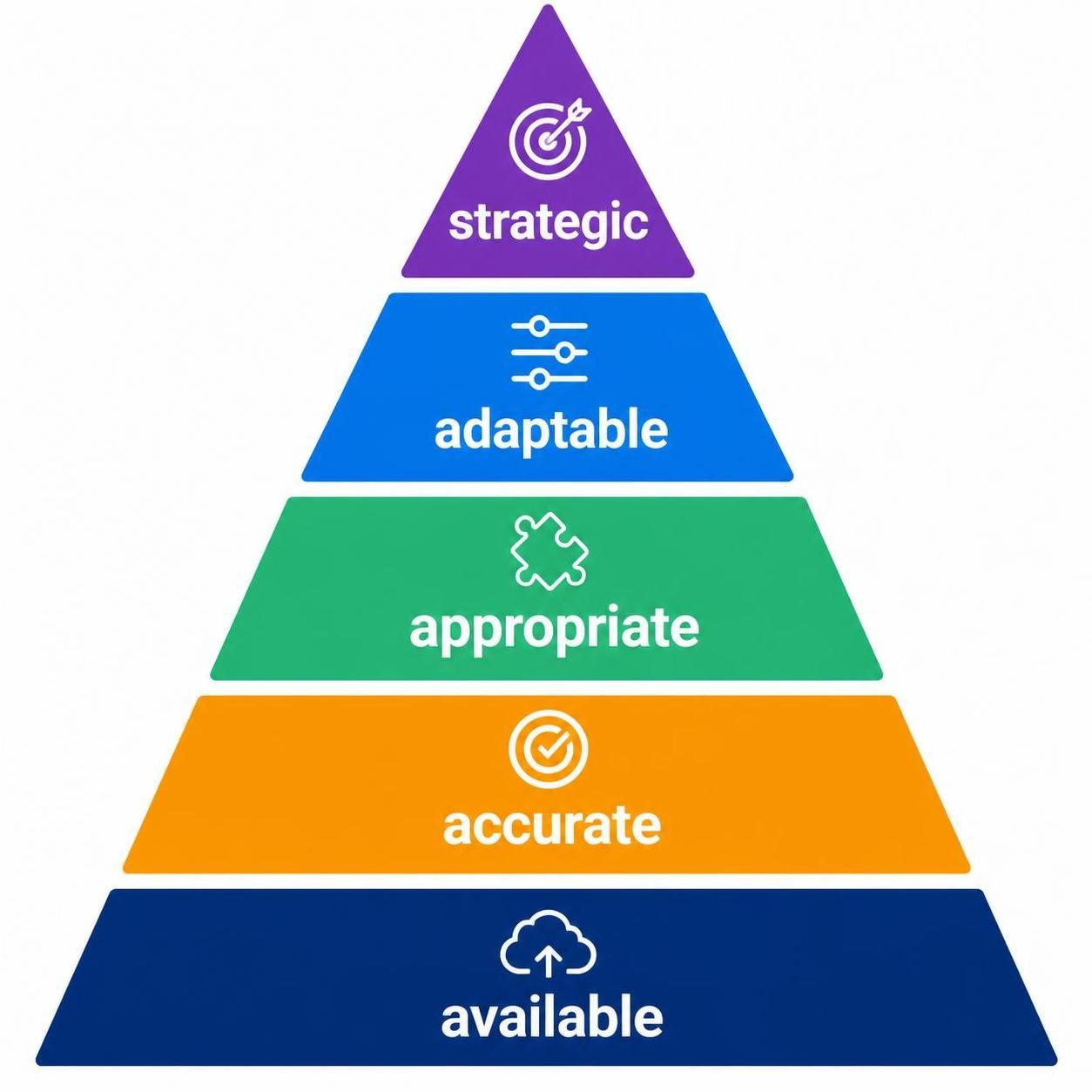
The content hierarchy of needs is a framework for closing that gap. Inspired by Maslow's hierarchy of needs, it helps communicate why content work has to happen in a specific order – not just what needs doing, but which parts have to come first for the rest to hold up.
The five levels
Hilary Marsh and Sarah O'Keefe each published a version of this hierarchy over a decade ago. The fact that their thinking still holds up shows that although technology changes, core requirements for quality content don't. My version uses both of their frameworks as inspiration into language that matches how I think and work.
From foundation to apex:
- Available – published, functional, discoverable and compliant with WCAG accessibility standards, so users with assistive technology can perceive and acces it.
- Accurate – factually correct, complete and up-to-date.
- Appropriate – engaging, in the right context, with consistent terminology, style, and tone.
- Adaptable – structured, semantic and machine-readable (AI-ready).
- Strategic – aligned with business goals, driving measurable outcomes.
A diagnostic tool, not just a model
Treat the hierarchy the way a doctor treats vital signs: as an indication of the health of your content. Much like a content audit, it provides a way to objectively spot weaknesses before they become bigger problems.
The logic mirrors Maslow's own: you can't pursue self-actualization while basic needs go unmet, and you can't pursue personalization or AI integration while your content isn't available or accurate. Get the foundation right and your highest-impact initiatives have something stable to stand on. Skip it, and those same initiatives fail – not because the ideas were wrong, but because the content underneath couldn't support them.
Why it works with stakeholders
The hierarchy's real value is as a communication tool. Because it's built on a model people recognize, it reframes your work from a list of tasks into a visible, logical progression.
When leadership feels pressure to jump straight to advanced personalization, this framework shows them that skipping the basics doesn't get them there faster – it delays them. A shaky foundation of inaccurate, inaccessible, or hard-to-find content will undermine any high-level initiative built on top of it.
Where AI fits
Implementing AI is the ultimate stress test for content operations. Most teams rush straight to automation, which mostly means using AI to produce bad content faster, at scale. To avoid that, consider:
Quality (the what). The content hierarchy of needs answers: is this content actually ready to perform? If your content fails here, AI won't fix it. It will amplify the failure.
Operations (the how). The Content Maturity Model answers a different question: is the organization mature enough to scale this? This is about people, process and technology, not the content itself.
Where to start
Before your next automation or personalization initiative, run your content against the five levels. Most teams find the gap isn't ambition but preparedness. Fix the foundation first, and the advanced work you want to do gets easier, not slower.
References
Marsh, H. (2013). The hierarchy of content needs: A new model for creating and assessing content. Content Company.
O'Keefe, S. (2014). Hierarchy of content needs. Scriptorium.